Blog

Archived posts: Books

Master it – How to cook today

We’ve just taken delivery of one of the first copies of Master it – How to cook today, the new book we recently designed for the fantastic chef Rory O’Connell.

Rory is one of the loveliest guys you could hope to meet, and an inspirational chef and teacher. He co-founded the hugely influential Ballymaloe Cookery School with his sister, Darina Allen, and runs his own cookery courses out of his home in East Cork.

The book is designed to be a riposte to the “just bung it in” school of cooking, focusing instead on carefully detailed instructions which don’t leave you guessing as to whether or not you’re getting it right.

Alistair went out to Ireland to art direct the photo shoot with the hugely talented photographer Laura Hynd (and got the chance to try far too many of Rory’s delicious dishes). Rory really stresses the importance of using the freshest seasonal ingredients, and took Alistair and Laura on a tour around Ballymaloe’s incredible gardens and greenhouses. Here are some of Alistair’s shots from there:

Check out the full set over here.

Master it: How to cook today is published by 4th Estate on 23 May.

Sebastião Salgado’s Genesis

Sebastião Salgado’s incredible new show, Genesis, opened recently at the Natural History Museum, and we went along over the weekend to take a look.

The exhibition is the result of eight years work, during which Salgado travelled the globe, seeking out examples of the unspoiled and the untouched – ‘my wish was to do a homage to the planet’. His travels, which began on the Galápagos Islands, took him through over thirty countries, from the arctic to the antarctic, from desert to jungle. Not bad for a man approaching his 70th birthday.

Salgado has previously done two major photographic projects – Workers (1993) which looked at manual labourers across the planet, and Migrations (2000) which studied the movements of peoples, driven by disaster, hunger, war and other pressures. With Genesis, his focus is much more on nature – landscapes and animals. People aren’t entirely absent though – he visited a variety of indigenous tribes, including the Omo Valley tribes in Ethiopia, the Zo’é in Brazil, and the Nenets of Siberia.

The exhibition at the Natural History Museum is the global premiere for the project (though individual stories from it have been serialised over the past eight years in magazines around the world), and the decision to hold it there adds a particular, and necessary, accent to the work.

In seeking to present the world in an untouched state (you’d be hard pressed to date any of these pictures to a particular century, let alone decade), Salgado is obviously hoping to show where we’ve come from, and how much we risk to lose. Framing the exhibition within the Natural History Museum helps to make this explicit in a way which it wouldn’t if the show was hosted in a more traditional gallery space.

Salgado is sometimes criticised for making his images too beautiful – that as a documentary photographer, he gives us too much art. But that seems to suggest that an image that communicates something powerful, that tells a particular story, can’t also be beautiful.

And this is a show that is wondrously beautiful. Shot after shot (and there are two hundred or so of them here) is breathtakingly stunning.

These thumbnails don’t even begin to do justice to the prints themselves – so make sure you get along to the exhibition if you can. (It will be travelling the globe in the coming years if you’re not in London.You can find the itinerary here.)

There is a book of course, published by Taschen.

And being Taschen, it’s also available in their oversized Sumo format as a two-volume limited edition, which comes with its own wooden stand designed by Tadao Ando. Here’s a shot of Salgado having a flip through a copy:

And if it feels like there’s a slight discrepancy between publishing a 704pp hardback book with a spread of almost a metre and being concerned for the world’s untouched spaces?

Well then it’s perhaps good to know that Salgado and his wife Lélia (curator of the Genesis show) have worked for two decades on the restoration of part of the Atlantic Forest in Brazil, hoping to plant a million and a half trees before they’re done.

A Monster Calls

It’s not often that a book leaves you sobbing in the darkness. But A Monster Calls, the staggeringly wonderful book from Patrick Ness, brilliantly illustrated by Jim Kay, does just that.

The book recently won the Carnegie Medal (for the story) and the Kate Greenaway Medal (for the illustrations), a pair of awards that are a big deal in the world of children’s publishing; and it was reading about the awards that prompted us to pick up a copy of the book.

The story is about a teenager, Conor O’Malley, who’s been having a terrible recurring nightmare, every night since his mother started her treatments.

“Conor looked at the ground, then up a the moon, anywhere but at the monster’s eyes. The nightmare feeling was rising in him, turning everything around him to darkness, making everything seem heavy and impossible, like he’d been asked to lift a mountain with his bare hands, and no one would let him leave until he did.”

The story was initially developed by the writer Siobhan Dowd before her premature death from breast cancer. Posthumously her editor, Denise Johnstone-Burt, asked Patrick Ness to continue the story for her. As Ness says in the author’s note to the book: “She had the characters, a premise, and a beginning. What she didn’t have, unfortunately, was time.”

Ben Dorland at Walker Books, the publishers, then brought in Jim Kay to illustrate the book. You can read all about how the book then came about in this Guardian article.

Kay’s monochromatic illustrations perfectly capture the atmosphere of the book without leading the reader down too specific a path. You can read more about how he created the illustrations on his site. For instance, about the first image below, he says: “Conor, the figure in the foreground, was painted very quickly in ink with a tatty brush – a temporary sketch while I worked on the rest of the image. I must have drawn at least 40 versions of him later on, but ended up using that first sketch as there was something awkward and unsettled about him. Subsequent drawings were just too self conscious. I’d love to have another go at this, I think I could force the perspective more –  get under the chair almost, and beneath the monster’s head.”

It’s an immensely powerful book, and truly beautiful. We can’t recommend it enough.

Page 1: Great Expectations

We’ve been dipping in and out of GraphicDesign&’s new publication Page 1: Great Expectations over the last couple of days, and it’s a mighty interesting read.

GraphicDesign& is a collaborative project from Lucienne Roberts and Rebecca Wright, which is aiming create publications which make connections between graphic designers and other subject areas. (We’d perhaps suggest that that’s an inherent part of graphic design – it’s what we do every day – connect with other disciplines to help communicate their messages.)

Page 1 is their first book, and it’s really interesting. The brief they sent out to 70 designers (mainly established names, but a few students too) was to take the first page of Charles Dickens’ Great Expectations, and lay it out however they saw fit, within the paramaters of a standard A format paperback, 110mm x 178mm.

In the final book, each designer is given a couple of spreads – one with their name and their design, and then another with the rationale for their design, and the specifics of typefaces and sizes.

This layout works really well – rather than just being a gallery space for a bunch of designs, we get the chance to listen to the designers explaining the thoughts and ideas behind those designs. Some of the designers might perhaps be accused of taking themselves just a tad too seriously, but in general there’s a pleasing breadth of responses, from the very dry to the very experimental.

Our studio partner Paul Finn was one of the designers included – here’s his page:

And here are a few others:

Great stuff. You can buy the book here.

Penguin English Library

This is the new animation that Penguin have commissioned from director Woof Wan-Bau to celebrate the launch of their new series, the Penguin English Library.

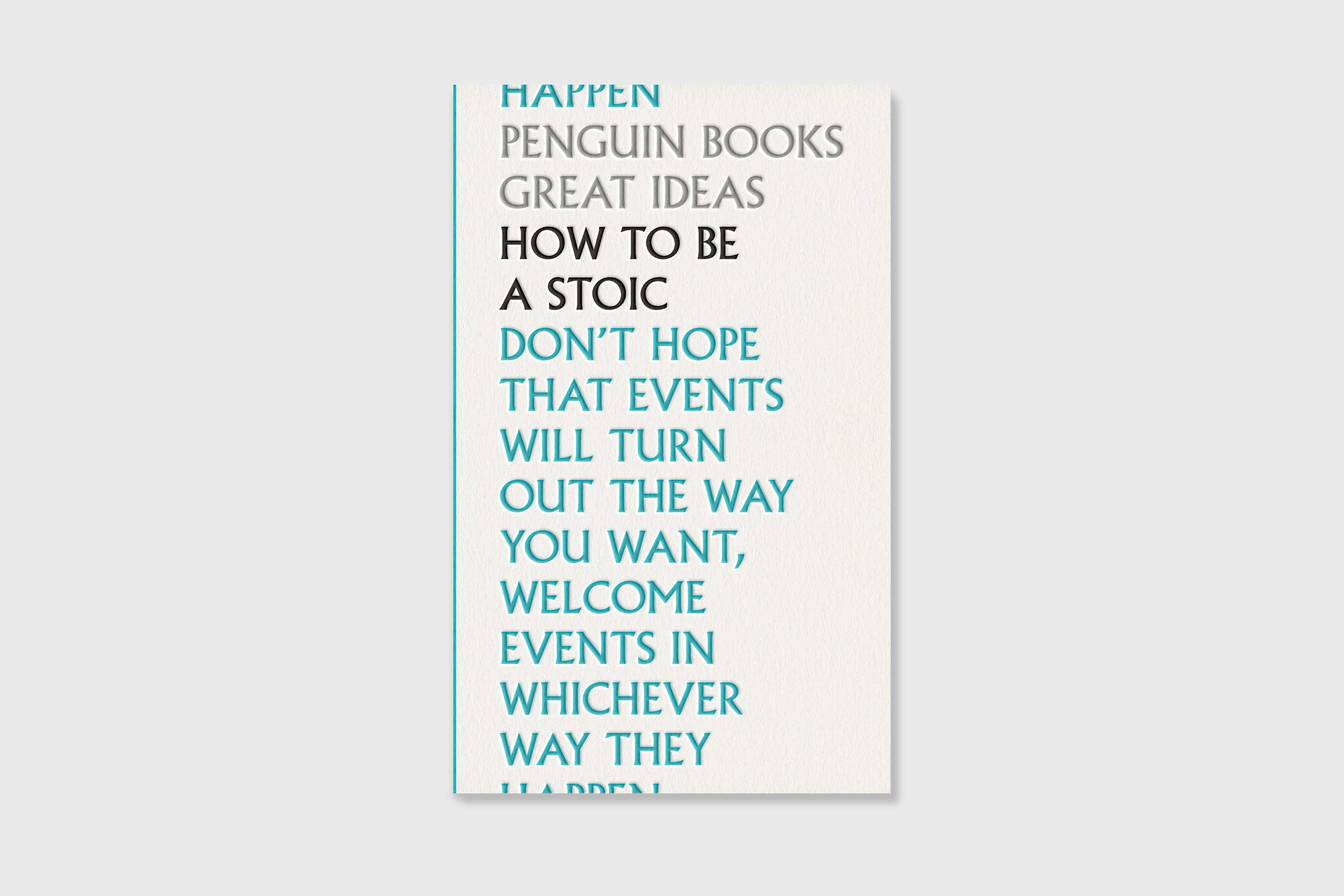
The series consists of “100 of the best novels in the English language”, starting with 20 launch titles, with cover designs from Coralie Bickford-Smith. (Check out the Facebook page to see details of the designs, and how they’ve played with the Timeline there.)

The covers are all well and good, but what got us really excited here was seeing the Penguin logo animated. It’s really beautifully done. Agencies love to talk about “bringing the brand alive”. Well here it is – living and breathing. Brilliant.

Birth of a Book

Shot, directed & edited by Glen Milner for the Daily Telegraph, this short film was shot at Smith-Settle Printers in Leeds. The book being printed is Suzanne St Albans’ ‘Mango and Mimosa’ published as part of the Slightly Foxed series.

via The Casual Optimist

Leap

So, what did you get up to with your extra day?

February 29th only comes around once every four years, so the good folks at Spread the Word decided they’d mark the leap day by getting writers from across the globe to collaborate on writing a book. In a single day. And then publishing it as an e-book today, as part of the World Book Day celebrations. And they asked us to design the book for them.

In preparation, they put together four teams of writers: in Kuala Lumpur, Delhi, London and Vancouver; and created a loose structure with four main characters, one in each city. The writing process kicked off in Kuala Lumpur, overlapping with Delhi, and then London and Vancouver joined in as the sun came up over their skies.

In London the main character was called Dave Martin. To help provide some inspiration for the writers, Alistair spent the day playing the fictional character, wandering around London taking pictures and uploading them on Twitter for the writers to respond to, using the hash tag #24hourbook. You can check out the feed at @Mr_Dave_Martin, or check out this slideshow of the images. Here are just a few:

Meanwhile, the writers created a story that pulled the characters and cities together. They shared their progress on a Facebook page, writing the book itself on Google Docs.

The writing was edited late into the night, and we kicked off the design very early this morning. We worked in InDesign, and created both an .epub and a .pdf version of the finished book, which was published on the Spread the Word website around 5pm this afternoon. (We’re fairly sure we’ll be tweaking and refining the design in the next few days.)

If you’d like to check it out, you can download the ebook in the ePub format (which should work on Apple’s iBooks on the iPad and iPhone; and on most e-readers – though not Kindles. It’ll work on Adobe’s Digital Editions, but won’t look so nice) or as a PDF.

(Oh, and the lovely cover image is by the equally lovely Lee Roberts).

The Next Chapter

People have been foretelling the death of the book for years now.

Obviously, that’s not going to happen entirely, but more and more of our reading is already taking place on e-readers (Amazon’s Kindle, Apple’s iPad, Barnes & Noble’s Nook, Sony’s Reader, and WH Smith’s Kobo amongst others).

The Kindle is the current king, currently available in the UK just in its monotone e-ink format, but in the US also in its full-colour multimedia Fire version, which is much closer to Apple’s ubiquitous iPad.

These days books are released in a whole stack of different formats. Nick Cave’s The Death of Bunny Munro, originally available as a signed and numbered limited edition hardback, is now available as a paperback, as an e-book for all the major formats, and as a multimedia app for the iPhone and iPad, and also as an audio book.

For book designers, whether they work on covers, texts, or on integrated books (words and pictures), the industry is obviously undergoing a metamorphosis. A metamorphosis that brings possibilities as well as peril.

Looking just at book covers, which are designed to lure in readers, they’re no longer primarily experienced physically, but instead as tiny thumbnails on a computer screen or handheld device. Instead of a wealth of sizes, of formats, of textures and of finishes, we just have pixels.

This isn’t a massively new situation – people have been buying books from Amazon for a good few years now. But where previously you would still end up with a physical book in your hands, that’s no longer necessarily the case.

To add insult to injury, in the current incarnation of iBooks on the iPad and iPhone you hardly even get to see covers at full size – they blink past momentarily when you start a book, but that’s about it. You do at least get a full size cover on the Kindle (well, full screen-size that is, which is always the same size no matter what book you’re reading), but on the e-ink version it’s always black and white.

At the same time though, there’s a resurgence in the love of the book as an object, with all the main publishers pumping out high-end versions of their backlists, such as Penguin’s Clothbound Classics. Surely a designer’s playground.

So, what is the next chapter for books?

For what it’s worth, our best guess is that paperbacks will start to disappear, as more and more people buy e-readers (how long is it before a major author releases a best-seller just as an e-book?). Hopefully though the various bits of e-book software will develop so that covers will still be considered a fundamental part of a book. We can also see lavish editions of hardbacks becoming more common; and integrated books perhaps becoming more and more interactive, following the lead of magazines.

But heck, what do we know?

Fortunately, if you’re out in New York, you can go and listen to some folk who might know just a little bit more.

The Next Chapter – The Design and Publishing of the Digital Book is a talk taking place at Parsons on Thursday 26 January. It’s organised by the AIGA NY, and is moderated by Chip Kidd. Should be a good one.

Hopefully they’ll be recording it for those of us who can’t make it…

Books, covered

There’s been a heck of a lot of press this month about book cover design, which is a Very Good Thing. It’s often woefully overlooked in the design industry, let alone in the world at large.

Most of the press comes as a direct result of Julian Barnes namechecking the designer Suzanne Dean (creative director at Random House) in his acceptance speech for the Man Booker Prize, for his book The Sense of an Ending.

Check out this thoughtful piece from Kathryn Hughes in the Guardian, which looks at the growth of the book as object, in the face of the unstoppable march of the e-reader. And then take a look at this piece in the Telegraph about the design process behind the Dean cover; as well as this piece from Nick Duerden in the Independent naming a few of his favourite cover designers. All good stuff.

If you want to go a bit deeper, then make sure you check out Dan Wagstaff’s excellent blog The Casual Optimist, where he’s just published his favourite covers from 2010 and 2011. In the 2011 list, he features Peter Mendelsund’s fantastic series of Kafka covers (top, and below).

Mendelsund, art director at Knopf and Pantheon, is a bit of a god-like genius – we featured his gorgeous Last Werewolf cover back in April. You should definitely take a look at his brilliantly erudite blog, Jacket Mechanical. And if that whets your appetite, then sate it with Debbie Millman’s brilliant Design Matters interview with him. His path to becoming a designer is quite unique, and his thoughts about how a book cover should work are well worth listening to.

Interestingly, he mentions that he’s worried that he might be out of a job within five years, because of the growth of e-readers, and the consequent diminishing of the importance of cover design. Well heck, if he’s gonna be out of a job, there’s not much hope for the rest of us… He also mentions that he himself hasn’t read a physical book in years, as he now reads everything on an iPad; so frankly Mendelsund, you’ve only got yourself to blame.

If that isn’t enough, then check out: designer John Gall’s lovely blog, Spine Out; the Caustic Cover Critic blog, which seems to scoop everyone else on featuring the very latest book cover designs; the Book Cover Archive, which does what it says on the tin, and also has a good set of links to more blogs; and Faceout Books, which features in-depth analysis of individual covers – such as this post about our studio buddy David Pearson’s covers for Penguin’s Great Journeys series.

And if you’re still not done after all that lot, then how about you read an actual book? We can recommend Joe Dunthorne’s lovely Wild Abandon.

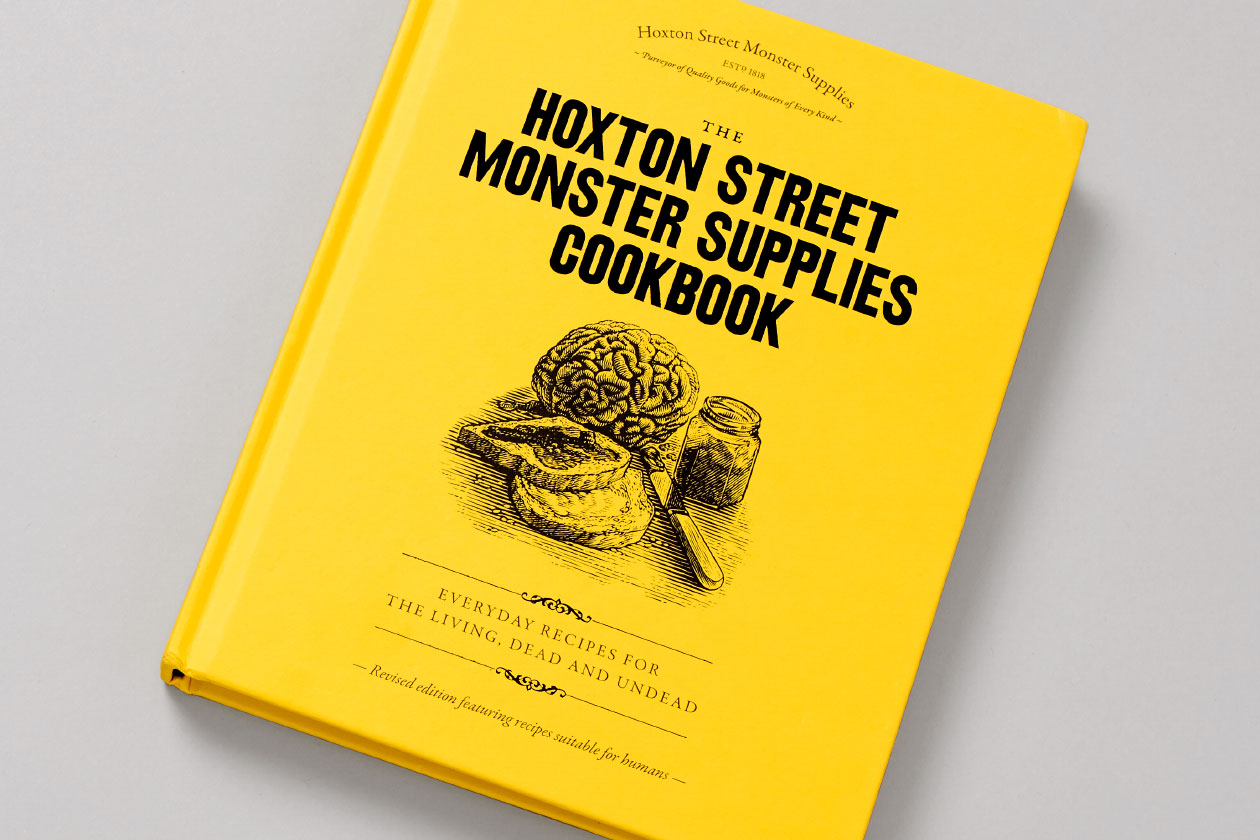
The Awfully Bad Guide to Monster Housekeeping

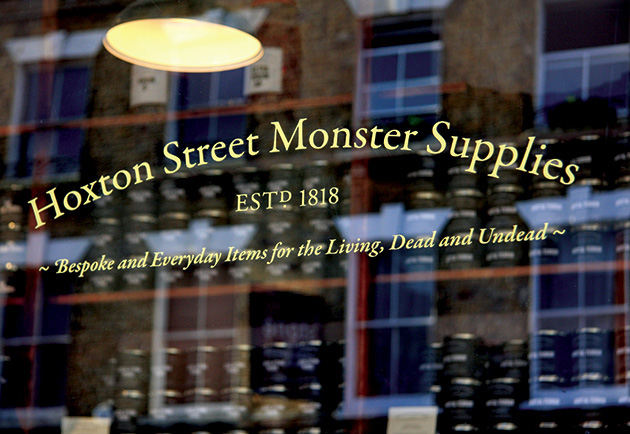
Just under a year ago, the Ministry of Stories, and its fantastical shop front, Hoxton Street Monster Supplies, opened its doors to the world. (You can read all about that on one of our earlier blog posts.)

Since then, they’ve both been doing really rather well.

The Ministry has helped thousands of kids with their writing, whether in group workshops, or with one-to-one mentoring. The kids get help with all kinds of writing – stories, lyrics, journalism, and even soap-opera scripts. They’ve published a book or two already, as well as a newspaper all about Hoxton Street.

The latest fruit of their labours is the fantastic Awfully Bad Guide to Monster Housekeeping. The original guide was rather tragically burnt to a crisp by a dragon called Vera, so the young writers of the Ministry were tasked with writing an entirely new guide, divided into four separate books: The Alphabet, Fashion & Grooming, Food & Recipes, and Home & Recreation.

They were helped out by a ridiculously talented selection of volunteer illustrators (Nadia Shireen, Katie Cleminson, Alexis Deacon, Hannah Shaw and Chris Wormell) and poets (Ross Sutherland, Polarbear, Laura DockrillNaomi Woddis, and Charlie Dark).

Each section is full of tips to help monsters manage their daily lives, and the books also feature pages where the readers can add in their own ideas.

The books were brilliantly designed by Ed Cornish, with art direction from We Made This.

The books are being sold individually for £3 each, or as a collection of four for just £10.

And heck, they’d make a rather fantastic Christmas present for any young monsters you might know. (Just saying.) You can pick them up at the Hoxton Street Monster Supplies shop.