Blog

Archived posts: Technology

Designs of the Year 2013

We nipped along to the Design Museum’s Designs of the Year show last weekend.

Self-styled as “the Oscars of the design world”, it’s a curious beast of a show, pulling together “the most innovative and imaginative designs from around the world, over the past year, spanning seven categories: Architecture, Digital, Fashion, Furniture, Graphics, Transport and Product”, with a view to crowning a single design as the best of the best.

Which means that you get a skyscraper (Renzo Piano’s Shard) being pitted against a social-media printing gizmo (Berg’s Little Printer).

There’s a lot of great stuff on show, but it was the projects that are demonstrably making people’s lives better that really caught our eye – and the rest of the designs rather suffered when compared against them.

We really loved the Little Sun designed by the artist Olafur Eliasson (the chap who installed the sun in the Tate’s Turbine Hall with The Weather Project) and and engineer Frederik Ottesen. It’s a low-cost solar powered LED lamp that gives up to five hours of light when fully charged. It’s designed to provide a practical, safe and efficient source of light for people living in rural communities off the electricity grid, helping them to work, study or cook at night.

It can be worn, hung or attached to walls, and is much safer and healthier than the kerosene lamp alternative.

And, even more brilliantly, folk in areas of the world with ready supplies of electricity (that’s you, dear reader) can buy them at full price, helping to make it available in off-grid communities at much lower prices.

Go shop.

Also helping kids in the developing world to read are the Child ViSion Glasses from the Centre for Vision in the Developing World, designed by the gents at Goodwin Hartshorn.

Designed to improve the eyesight of kids aged 12-18 (or possibly to create a Wally Olins clone army) these groovy self-adjustable specs use fluid-filled lens technology: a silicone oil is injected into the space between two membranes to adjust the prescription until it’s right for the user (the design is based on something similar for adults, the Adspecs, also developed by the CVDW).

The package includes a simple eye test, and the lenses can be adjusted by any adult. At this stage they’re still undergoing clinical trials, but heck, what a great idea.

Another stunning idea came from the folks at independent non-profit ColaLife, who have developed a novel way of getting life-saving medicines to people in rural areas of Africa – by hitching a ride with Coke.

They realised that soft-drinks giant Coca-Cola has an incredible distribution network: you can buy a Coca-Cola virtually anywhere in the developing world – but that in those same places 1 in 9 children die before their 5th birthday from simple, preventable causes like dehydration from diarrhoea.

ColaLife decided to piggyback on top of Coca-Cola’s distribution network, and developed the Aidpod, a package which can slot into the empty spaces left between soft drinks bottles when they’re stacked in a crate. The pods are designed to carry ‘social products’ – oral rehydration salts, high-dose vitamin A, water purification tablets – to save children’s lives. By using an already established network, medicines can reach communities for little or no cost.

The Kit Yamoyo, nominated for an award, is an Anti-diarrhoea pack which they’re trialling in Zambia at the moment. The original concept was by Simon & Jane Berry (founders of Colalife), with design by Tim Llewellyn for PI Global.

Read more about it all here.

Meanwhile, over in the Architecture category, we loved the renovation of Tour Bois le Prêtre: a 17 storey tower block, on the edge of the 17th Arrondisement in Paris, that was being threatened with demolition.

In 2005 a competition was organised by Paris Habitat, the Paris Office for Public Housing, to renovate the building. Lacaton & Vassal studio put together a retrofitting scheme for the block, using prefabricated balconies, which cost £15 million, around half of the projected demolition and rebuilding cost; and which also meant minimal disruption for the inhabitants of the block.

A pioneering example of how renovated buildings can create great housing. Be good to see some more of that sort of thing going on in the UK. (Read more about the project in this New York Times article.)

Over in the Graphics category, it was the new Australian cigarette packs that caught our eye.

Thanks to the Australian Tobacco Plain Packaging Act, as of 1 December 2012, all cigarettes sold there have to be sold in plain packaging. So there’s no branding to speak of, just warnings, graphic images of the dangers of smoking, and product names.

As the act states, this was done to: “(a)  reduce the appeal of tobacco products to consumers, (b)  increase the effectiveness of health warnings on the retail packaging of tobacco products, (c)  reduce the ability of the retail packaging of tobacco products to mislead consumers about the harmful effects of smoking or using tobacco products.”

It’s design doing the exact opposite of what it normally does. It’s ugly, unpleasant, and uncomfortable, and it’s intentionally trying to dissuade you from making a purchase. The packaging colour has been specified as Pantone 488C, after research by the Australian Department for Health and Ageing discovered it to be the least attractive colour for packaging.

Poor old 488C.

It’s not beautiful, but it may well be very effective.

Although.

It did remind us of the Death Cigarettes brand from the 90s, which was equally up front about the dangers of smoking.

It’ll be interesting to see if the Australian packs pick up a similar cachet amongst rebellious youth…

Other than those projects, the Zumbtobel Annual Report, by Brixton design studio Brighten the Corners and Anish Kapoor, is a real stunner, set in two parts, with one part consisting solely of a series of full-bleed chromatic spreads (you really need to have a copy in your hands to experience it properly).

And the Ralph Ellison series of book covers by Cardon Webb are also all kinds of lovely.

And of course, Thomas Heatherwick Studio’s lyrical Olympic Cauldron for the London 2012 is nominated too, and deservedly so. It was the design highpoint of the Olympics, and there was a real sense of awe watching it open and close during the ceremonies.

All in all it’s a fascinating show – but we definitely came away with the feeling that design is at its best when it’s directly helping make the world a better place.

And we were also struck by this bit of text from the permanent collection on the floor above the Designs of the Year show:

“The most successful designs are those that endure and continue to be relevant many years after they are first introduced. These are the icons that define the landscape of design. The bicycle, the ball-point pen and Anglepoise lamp are all examples, where the basic form has remained the same for decades.”

It’ll be really interesting to see if which, if any, of this year’s crop of designs endure for many years to come.

Curiosity

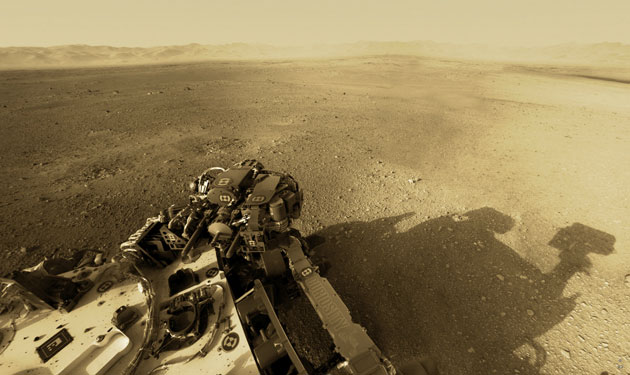
360 degree panorama of the Curiosity rover on Mars. Take a look in full screen. Mind-blowing. (Not quite sure how official this is – it’s been put together by the folks at 360pano.eu, but doesn’t seem to have been linked to yet by NASA.)

If you’re, you know, curious about Curiosity, check out its Facebook page and Twitter feed, or head over to NASA.

Hmmm. Calling Curiosity ‘it’ feels wrong somehow. Perhaps it’s a she. We’ve sent a tweet to find out.

Dickens Dark London

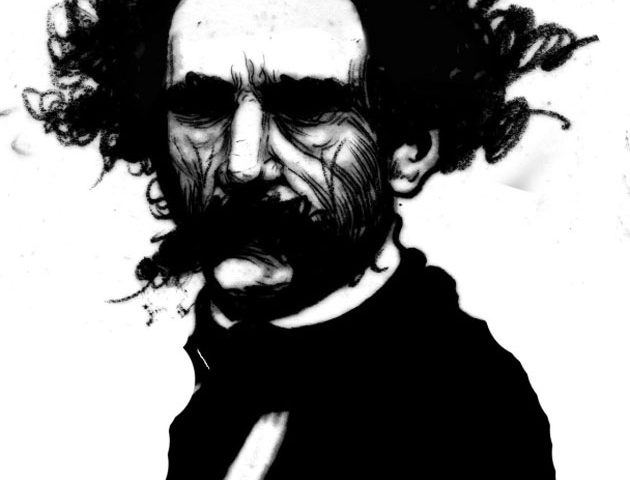
You’d be hard pressed not to have noticed it, but this year is the 200 year anniversary of Charles Dickens’ birthday. The Museum of London is hosting a major exhibition about his life, and to coincide with that, they’ve created a rather delicious iPhone & iPad app called Dickens Dark London.

The app is an interactive graphic novel, illustrated by the frankly brilliant David Foldvari, and based on Dickens’ Sketches by Boz. It will run to five issues (just the first one is available so far), each one centred on a different location. As well as Foldvari’s stunning images, the app includes excerpts from the sketches, read in gravelly tones by the actor Mark Strong; as well as a map that shows story locations on a map from 1862, which overlays the standard Google Maps.

The first issue (available free) is set in Covent Garden’s Seven Dials - here are a few of the pages:

Simply stunning.

Apple’s faux-leather grimness

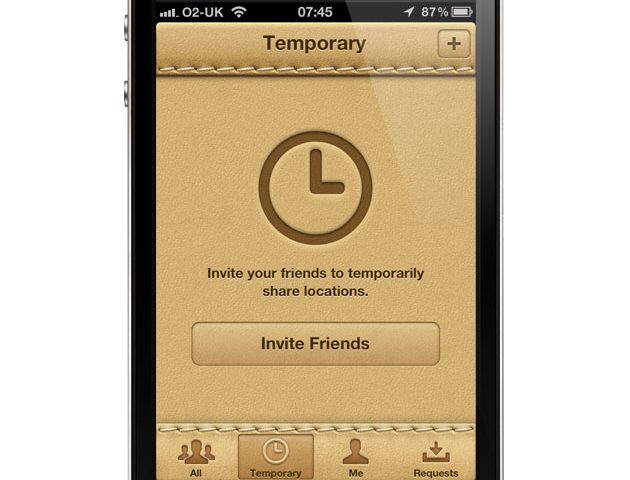
Dear Apple, please can you stop designing your interfaces with these faux-leather effects? They’re horrible.

Find My Friends (top) is Apple’s new stalker app on iOS 5, and its first iteration seems really clumsy – which is peculiar, given that companies like Loopt have already shown how you can do the same thing properly.

iCal is the native calendar app on Macs and other Apple devices – it used to be clean and functional, but they’ve messed with it for iOS 5 and Mac OS Lion, so that it now works less well.

And that faux-leather menu bar nonsense… eurghh.

Apple – please stop it.

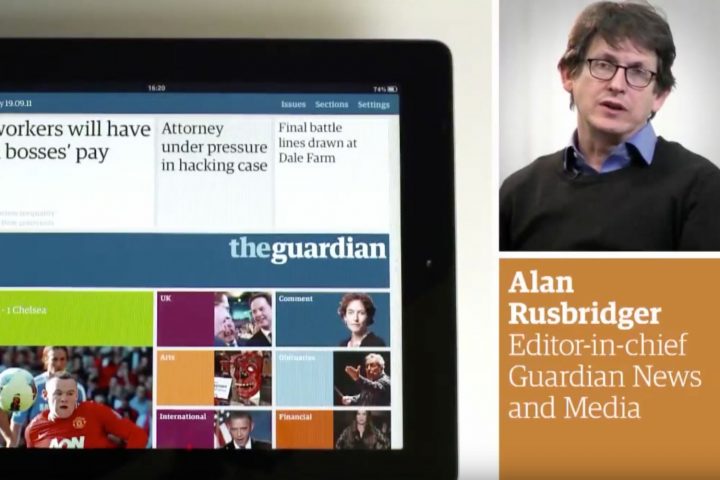
Here comes the Guardian iPad app…

An enjoyably understated video from the gang at the Guardian (despite the muzak soundtrack), advertising their upcoming app for the iPad. Some interesting stuff about the grid they’re using to define clear hierarchies for their stories – something that most digital versions of print have yet to resolve.

Steve Jobs 1955-2011

We’re very sad to hear about the death of Steve Jobs, the inspirational co-founder of Apple, after a lengthy battle with pancreatic cancer.

As the homepage of www.apple.com currently says:

“Apple has lost a visionary and creative genius, and the world has lost an amazing human being. Those of us who have been fortunate enough to know and work with Steve have lost a dear friend and an inspiring mentor. Steve leaves behind a company that only he could have built, and his spirit will forever be the foundation of Apple.”

Personally, we’ve used Apple devices since 1996, including Apple Mac computers, iPods, iPhones, Macbook Pro laptops and even an Apple TV. All of them were generally a joy to use, and blended incredible product design with brilliant graphical user interfaces – which stands in stark contrast to most other tech products.

Jobs helped to define technology at the turn of the century, and revolutionised several industries, all the while with an absolute focus on the importance of design.

Guardian obituary.

Ace Jet 170 on pigeons, planes, and asterisks in the sky

~ While Alistair is away cycling the length of Great Britain, we’ve invited twenty disgustingly talented people to each write a post for our blog. Today’s post is from the inimitable Richard Weston, the man behind the brilliant Ace Jet 170 blog. ~

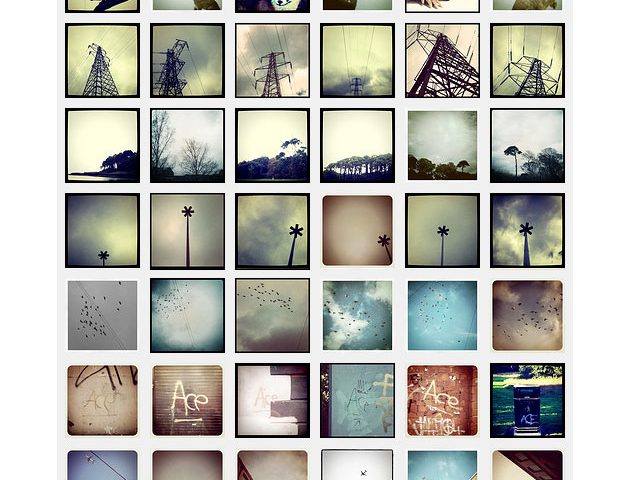
207. That’s how many people know I am crazy about Instagram at the moment. Naturally nosey, it fits me like the proverbial hand attire. Spare moments, and some that aren’t actually spare, are spent peering into places I should probably not peer for potential Insta-fodder. Down darkened allies, over rooftops, into murky rivers. So far, it hasn’t got me into trouble.

On the surface Instagram looks like a gimmicky, fake retro photo filtering application. Masking, as it does, bloody awful photos in old-style falseness. You probably know of it, even if you don’t use it. Because I use it frequently, every day, I find it hard to imagine you aren’t at least aware of it and its auto-counterfeitery.

Perhaps you’re like I used to be. At first, I was repelled by Instagram’s faux photo styling. There’s no craft in it. You point, you click, you pick a filter. But hang on. Your crap photo, surprisingly, looks better. It really does. Often, not just better; more than better.

But the reality is, Instagram is much more than a tricksy little app for polishing your photographic turds. Photo sharing is ace. Arguably way more fun, certainly more intimate, than Twitter; it is the natural successor to moment-sharing-as-text. Especially for snoopers.

So we can show people what we’re seeing. We can show off a bit (hey, look where I am! / look what I’ve got!). And we can collect instances because we can feed them, effortlessly, straight into Flickr or Facebook. Or even into more purpose-built diarising apps like Momento.

And like the way Twitter can make you think more about the words you use and can act as a channel for those thoughts you have that are of no real value to anyone, Instagram can encourage you to look around more and snap the things you would ordinarily smile at and forget. Like the flock of pigeons that circle overhead, the planes that fly over our studio, and the asterisks in the sky.


~ Alistair is raising money for Cancer Research UK during his ride – please wander over to his Just Giving page and donate a little cash. ~

Mike Dempsey on visual culture

~ While Alistair is away cycling the length of Great Britain, we’ve invited twenty disgustingly talented people to each write a post for our blog. Today’s post is by the brilliant graphic designer Mike Dempsey, who has done a ridiculous amount of incredible design during his life, and now runs Studio Dempsey. ~

Hmmm, visual culture. Something we, in this funny old business of design, are submerged in. We see stuff when others don’t. It’s what we do. It’s what we love. But somehow in this increasing digital age, our visual dexterity is being diverted…

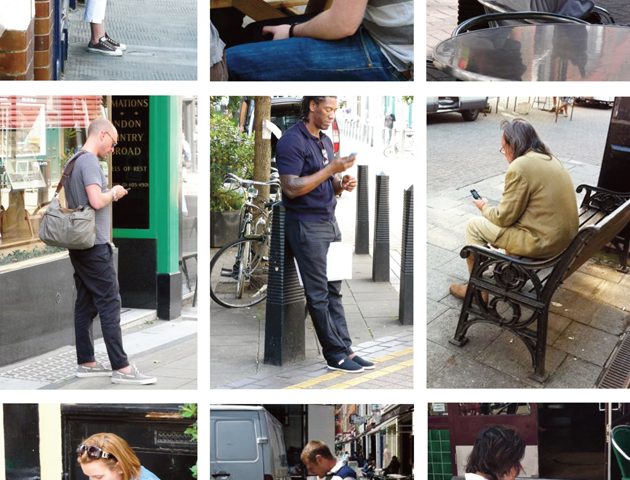
Have you noticed how many people walk straight out into the road or onto a zebra crossing without looking because they are texting or chatting on their mobile? Or others having half engaged conversations with friends because they are too distracted by their emails or texts? Maybe you haven’t, because it’s exactly what you are doing right now reading this?

Yes, we’ve all got one and spend more time looking at it than our surroundings. SMS, Twitter, Facebook, Linkedin, YouTube, and I’m sure many more new kids on the block, have taken us over like those big pea-poddy things in ‘Invasion of the Body Snatchers’.

As wonderful as these innovations are, they come at a price. And it’s not just financial. They deprive us from being in the ‘here and now’. For a so-called ‘visually aware’ community we are losing our sight and the protocol of real social interaction.

Digital has accelerated our world. Freddie Mercury’s, ‘…I want it all, and I want it now’ is a reality. Bookshops, music stores, fashion outlets and many more are closing down in favour of virtual shopping; and the recent demise of Design Week has brought it closer to home.

Many years ago I conducted a workshop in order to help Royal Mail discover how they could improve the accessibility of their stamps for the partially sighted and blind community. The meeting was held at the Royal National Institute for the Blind in a rather bland room in the basement. As I watched this small group with their heighted tactile sensitivity navigating perforations, size, shape and Braille, all in minute detail, I suddenly realised that I was the only person in the room with something very precious. My sight. And that day in that soulless basement has stayed with me, and I never undervalue the gift I have. I look everywhere and anywhere and resist being mesmerised by that irritating, but necessary, little gadget that we all carry around.

So slow down, put your phone away and look around you. And engage with those passing moments. They can be a joy to behold…

Like this…

Or this…

Or even Alfred Hitchcock on the 38 bus. And what is he up to?…

If you need a primer to get into the zone of the beauty of our world, take in Terrence Malick’s stunningly shot The Tree of Life photographed by the brilliant cinematographer Emmanuel Lubezki – a man who truly uses his gift…

Take a look here:


~ Alistair is raising money for Cancer Research UK during his ride – please wander over to his Just Giving page and donate a little cash. ~

Mike Dempsey

Lorry Blind Spots

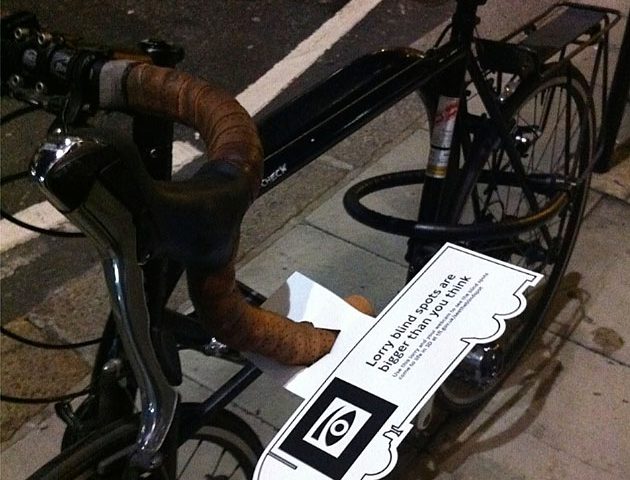
This is great. Direct marketing of the very best kind. Transport for London have been blitzing bikes in town with these flyers, which slot onto your handlebars. They’re printed in a single colour, which is nice and economical, and the stock’s been coated so that they don’t go soggy if it rains before you return to your bike. And the call to action is dead simple: “Use this lorry and your webcam to see the blind spots come to life in 3D at tfl.gov.uk/seetheblindspot“.

When you hold the flyer up to your webcam (you can print your own flyer out on the site if you don’t have one already), it kicks in with a spot of augmented reality, showing a lorry on your screen, which is surrounded by bikes that sit in the lorry’s blind spots. You can rotate the flyer / lorry to see the blind spots to both the front and back of the lorry. And at the same time, the key message scrolls onto the side of the lorry. And the wheels turn too!

Good work TFL.

LDF10: Outrace

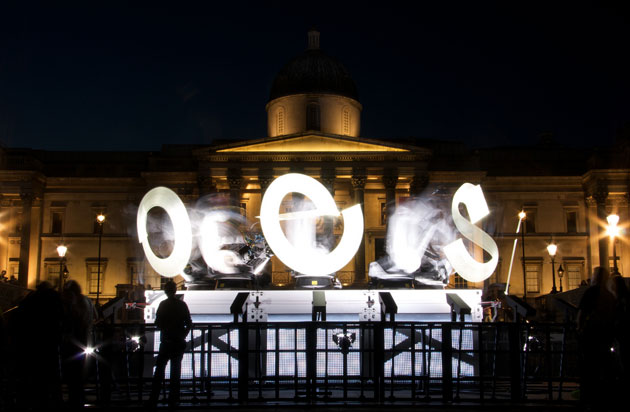
We nipped across to Trafalgar Square last night to check out Outrace, one of the centrepieces of this year’s London Design Festival.

Outrace is a large scale installation of eight industrial robots (on loan from Audi), each of which has a powerful LED head attached to the end of its arm. If you log on to the Outrace website you can submit a message of up to 70 characters which the robots will then recreate in a 3D cursive graffiti font written in light (assuming they deem your message interesting enough – we quite liked “Bow to your robot overlords puny humans” which someone has already posted). Long exposure cameras placed round the base of the installation then capture these interactive light paintings, and display them on screens just below the robots, as well as sending them to their YouTube channel (it’s 2010, nothing exists unless it’s on YouTube), and emailing them back to you. Here’s ours (with a couple of stray characters, guess those robots aren’t infallible…):

The project was designed by Clemens Weisshaar and Reed Kram, who in the newspaper handed out at the installation are described as being very different from standard ‘professional designers’: ”You will know these genteel people by their office pallor and their dainty Apple iPhones. Reed Kram and Clemens Weisshaar do not fit this mould.”

Well boys, judging by your bio shots on the Outrace site, you fit the mould just fine:

To be fair, the newspaper has a fairly tongue-in-cheek tone (in parts – other parts are dripping with painfully sincere academic analysis of the project) so perhaps us genteel folk shouldn’t get too worked up…

The project is evidently mind-blowingly complex as a piece of software engineering, which is all well and good, but what’s the actual experience like?

Well, it’s kinda groovy to have a gang of beautiful robots girating around in Trafalgar Square – you can check out the live stream to see them doing their thing – they’re like a nest of rhythmic vipers, dancing to some unheard tune (Bjork’s All is Full of Love perhaps?) Very beautiful.

As an interactive text piece though it works far better online than it does as a physical piece – when you’re in the square you can’t see the letterforms left by the light traces (unless you photograph them at night as we did, which means taking an SLR and a tripod along), and the screens below the robots showing the messages don’t feel entirely connected to what’s going on above them. And while we were there they’d run out of the explanatory newspapers, which was leaving people in the dark, as it were. The online films are great though, and the graffiti font works well for the kinds of messages that are being sent in (‘Kirstin, I love you with all of my heart. A xxx’ being one of the latest), pleasantly undercutting the mechanical movements of the robots.

All in all a fine centrepiece to the festival. Outrace continues until tomorrow evening (23 September) so get down there sharpish if you want to take a look.

Larger versions of our shots are on Alistair’s LDF10 Flickr set.