Blog

Archived posts: Graphics

Carters Steam Fair

A couple of weekends ago we got the chance to visit the fantastic Carters Steam Fair while it was visiting Clapham Common.

Carters is a vintage travelling fun fair, entirely run by the Carter family, after John and Anna Carter bought their first ride, the Jubilee Steam Gallopers (below) in 1977. The ride was originally built by Robert Tidman & Sons of Norwich, in 1895; and the Carters extensively repaired and renovated it to get it looking as fine as it does today.

The other main ride they have that’s run on steam is the glorious Excelsior Steam Yachts ride (top and below), built in 1921.

The whole fair features a staggering wealth of traditional fairground art and signwriting, featuring work by Hall and Fowle:

“The later rides owned by Carters Steam Fair are painted in a style of dramatic three-dimensionality by the masters of fairground painting in the first half of the 20th century: Hall and Fowle. Edwin Hall was a master painter producing some beautifully set out and composed Art Deco designs that still stand out to this day; Fred Fowle joined forces with him later. Fowle’s work is unmistakeable in its design and skill, using gold and aluminium leaf, flamboyant enamels and a lot of guts he made some of the most extraordinary and exuberant artwork that can be seen on the fair to this day, most notably the Skid, the Octopus, and the Hook a Duck hoopla stall which are owned by Carters Steam Fair.”

Everything on the fair is still hand-painted, with incredible skill and style, by the Carter family. Indeed, Joby Carter even runs 5-day signwriting courses – the next one coming up this November.

It’s just an amazing place to visit. They even have a coconut shy, and a fantastic penny arcade, which even has a suitably creepy Jolly Jack:

And of course the rides themselves are brilliant.

The fair will be at Belair Park in West Dulwich for the next two weekends, and travelling all round London through to November (check their full diary here). Do go along if you get a chance.

Potter prints

Yesterday, at one of the Clerkenwell Design Week events, we bumped into the very lovely Miraphora Mina and Eduardo Lima, who worked on the graphic design for all eight of the Harry Potter films. Collectively known as Minalima, they’ve recently launched The Printorium, an online market place for a series of lovely fine art prints based on their work for the films.

The prints come in two formats – limited editions of 1,000, embossed and signature stamped; and limited editions of 250, hand signed, which have additional hand-worked details like gold foiling. Where possible, they’re delivered by owl.

It’s really great to see this stuff living on after the movies, and heck, they’d make the most amazing gifts for Potterheads (we had to look that up).

The print below features some ads from from The Daily Prophet, the wizarding newspaper in the films.

Miraphora and Eduardo also have a selection of self-initiated prints available on the site, which are equally lovely.

There’ll be an exhibition of their work at The Conningsby Gallery in London from 17 to 28 June.

Wizard.

London Transport Museum Acton Depot

We made our way over to London Transport Museum’s Acton Depot yesterday – it’s where they house the majority of the collection that’s not on show at the museum itself. As part of the tube’s 150th anniversary they’re having a series of events there, and this weekend was their Open Weekend.

The depot houses a selection of retired tube trains, buses, trams, trolleybuses; and a densely packed mezzanine full of an incredible selection of old signs.

It’s an amazing treasure trove.

And there’s a host of other wonders too. Back on the ground floor there’s a cabinet of woodblock letters, featuring various versions of the Johnston typeface designed  in 1917 by calligrapher Edward Johnston (who actually lived not so far away from Acton, in Chiswick). This was the typeface used throughout the London Underground, and still in use today (in the slightly modified form of New Johnston).

There are some bits of metal type lying around too:

There’s also a model of Strand Station, a now defunct station which you can occasionally take tours around.

There are also examples of the logo designed for the Victoria Line:

and some lovely old ticket machines:

How binary are those? Put your money in, get a ticket. Or don’t put any money in, push a button, and get an Authority to Travel. Brilliant.

Fantastic stuff.

If you missed it this weekend, they’re having a series of guided tours throughout the year.

If you’d like to find out more about the London Underground’s design history, then you should really get yourself a copy of Mark Ovenden’s truly marvellous book London Underground By Design.

Designs of the Year 2013

We nipped along to the Design Museum’s Designs of the Year show last weekend.

Self-styled as “the Oscars of the design world”, it’s a curious beast of a show, pulling together “the most innovative and imaginative designs from around the world, over the past year, spanning seven categories: Architecture, Digital, Fashion, Furniture, Graphics, Transport and Product”, with a view to crowning a single design as the best of the best.

Which means that you get a skyscraper (Renzo Piano’s Shard) being pitted against a social-media printing gizmo (Berg’s Little Printer).

There’s a lot of great stuff on show, but it was the projects that are demonstrably making people’s lives better that really caught our eye – and the rest of the designs rather suffered when compared against them.

We really loved the Little Sun designed by the artist Olafur Eliasson (the chap who installed the sun in the Tate’s Turbine Hall with The Weather Project) and and engineer Frederik Ottesen. It’s a low-cost solar powered LED lamp that gives up to five hours of light when fully charged. It’s designed to provide a practical, safe and efficient source of light for people living in rural communities off the electricity grid, helping them to work, study or cook at night.

It can be worn, hung or attached to walls, and is much safer and healthier than the kerosene lamp alternative.

And, even more brilliantly, folk in areas of the world with ready supplies of electricity (that’s you, dear reader) can buy them at full price, helping to make it available in off-grid communities at much lower prices.

Go shop.

Also helping kids in the developing world to read are the Child ViSion Glasses from the Centre for Vision in the Developing World, designed by the gents at Goodwin Hartshorn.

Designed to improve the eyesight of kids aged 12-18 (or possibly to create a Wally Olins clone army) these groovy self-adjustable specs use fluid-filled lens technology: a silicone oil is injected into the space between two membranes to adjust the prescription until it’s right for the user (the design is based on something similar for adults, the Adspecs, also developed by the CVDW).

The package includes a simple eye test, and the lenses can be adjusted by any adult. At this stage they’re still undergoing clinical trials, but heck, what a great idea.

Another stunning idea came from the folks at independent non-profit ColaLife, who have developed a novel way of getting life-saving medicines to people in rural areas of Africa – by hitching a ride with Coke.

They realised that soft-drinks giant Coca-Cola has an incredible distribution network: you can buy a Coca-Cola virtually anywhere in the developing world – but that in those same places 1 in 9 children die before their 5th birthday from simple, preventable causes like dehydration from diarrhoea.

ColaLife decided to piggyback on top of Coca-Cola’s distribution network, and developed the Aidpod, a package which can slot into the empty spaces left between soft drinks bottles when they’re stacked in a crate. The pods are designed to carry ‘social products’ – oral rehydration salts, high-dose vitamin A, water purification tablets – to save children’s lives. By using an already established network, medicines can reach communities for little or no cost.

The Kit Yamoyo, nominated for an award, is an Anti-diarrhoea pack which they’re trialling in Zambia at the moment. The original concept was by Simon & Jane Berry (founders of Colalife), with design by Tim Llewellyn for PI Global.

Read more about it all here.

Meanwhile, over in the Architecture category, we loved the renovation of Tour Bois le Prêtre: a 17 storey tower block, on the edge of the 17th Arrondisement in Paris, that was being threatened with demolition.

In 2005 a competition was organised by Paris Habitat, the Paris Office for Public Housing, to renovate the building. Lacaton & Vassal studio put together a retrofitting scheme for the block, using prefabricated balconies, which cost £15 million, around half of the projected demolition and rebuilding cost; and which also meant minimal disruption for the inhabitants of the block.

A pioneering example of how renovated buildings can create great housing. Be good to see some more of that sort of thing going on in the UK. (Read more about the project in this New York Times article.)

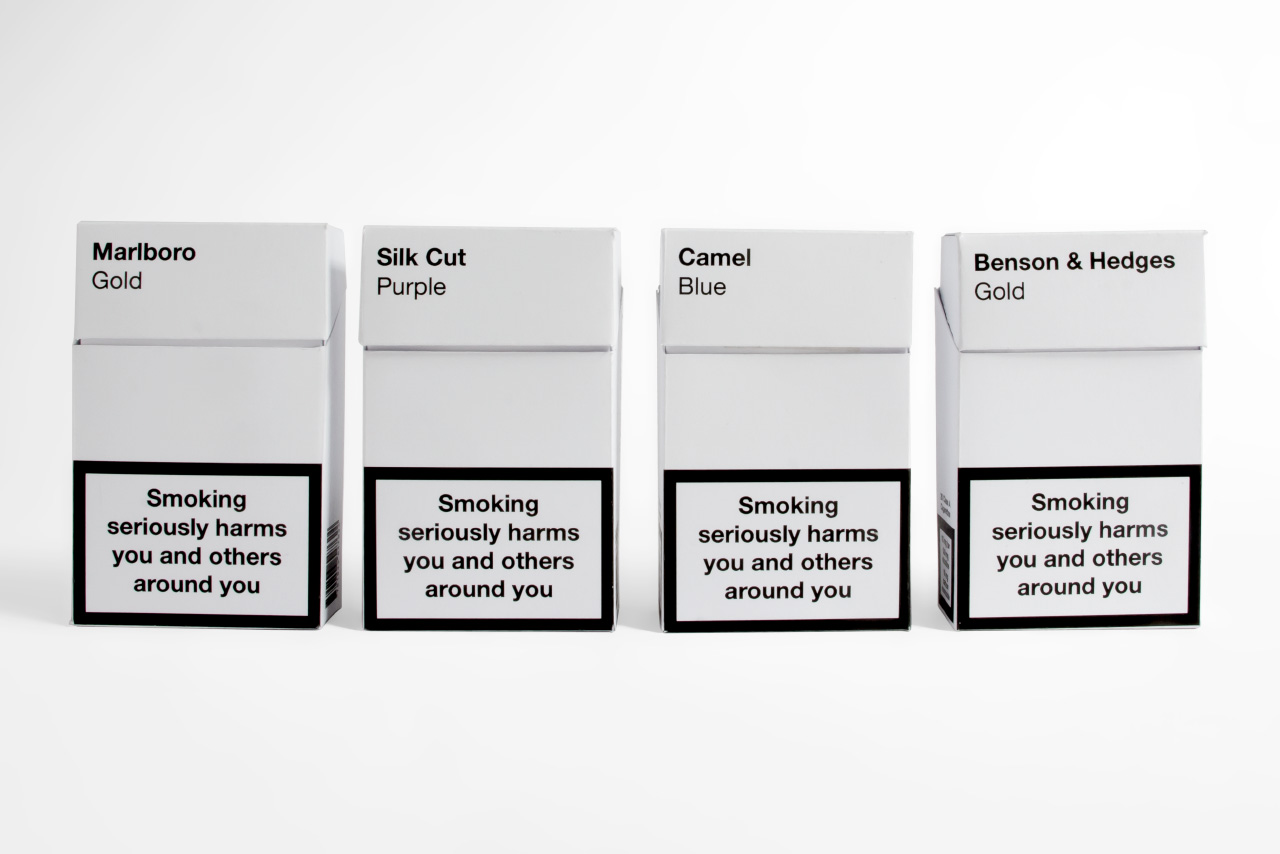
Over in the Graphics category, it was the new Australian cigarette packs that caught our eye.

Thanks to the Australian Tobacco Plain Packaging Act, as of 1 December 2012, all cigarettes sold there have to be sold in plain packaging. So there’s no branding to speak of, just warnings, graphic images of the dangers of smoking, and product names.

As the act states, this was done to: “(a)  reduce the appeal of tobacco products to consumers, (b)  increase the effectiveness of health warnings on the retail packaging of tobacco products, (c)  reduce the ability of the retail packaging of tobacco products to mislead consumers about the harmful effects of smoking or using tobacco products.”

It’s design doing the exact opposite of what it normally does. It’s ugly, unpleasant, and uncomfortable, and it’s intentionally trying to dissuade you from making a purchase. The packaging colour has been specified as Pantone 488C, after research by the Australian Department for Health and Ageing discovered it to be the least attractive colour for packaging.

Poor old 488C.

It’s not beautiful, but it may well be very effective.

Although.

It did remind us of the Death Cigarettes brand from the 90s, which was equally up front about the dangers of smoking.

It’ll be interesting to see if the Australian packs pick up a similar cachet amongst rebellious youth…

Other than those projects, the Zumbtobel Annual Report, by Brixton design studio Brighten the Corners and Anish Kapoor, is a real stunner, set in two parts, with one part consisting solely of a series of full-bleed chromatic spreads (you really need to have a copy in your hands to experience it properly).

And the Ralph Ellison series of book covers by Cardon Webb are also all kinds of lovely.

And of course, Thomas Heatherwick Studio’s lyrical Olympic Cauldron for the London 2012 is nominated too, and deservedly so. It was the design highpoint of the Olympics, and there was a real sense of awe watching it open and close during the ceremonies.

All in all it’s a fascinating show – but we definitely came away with the feeling that design is at its best when it’s directly helping make the world a better place.

And we were also struck by this bit of text from the permanent collection on the floor above the Designs of the Year show:

“The most successful designs are those that endure and continue to be relevant many years after they are first introduced. These are the icons that define the landscape of design. The bicycle, the ball-point pen and Anglepoise lamp are all examples, where the basic form has remained the same for decades.”

It’ll be really interesting to see if which, if any, of this year’s crop of designs endure for many years to come.

Poster Art 150

We dropped in to the London Transport Museum over the weekend to check out their truly fantastic new show, Poster Art 150.

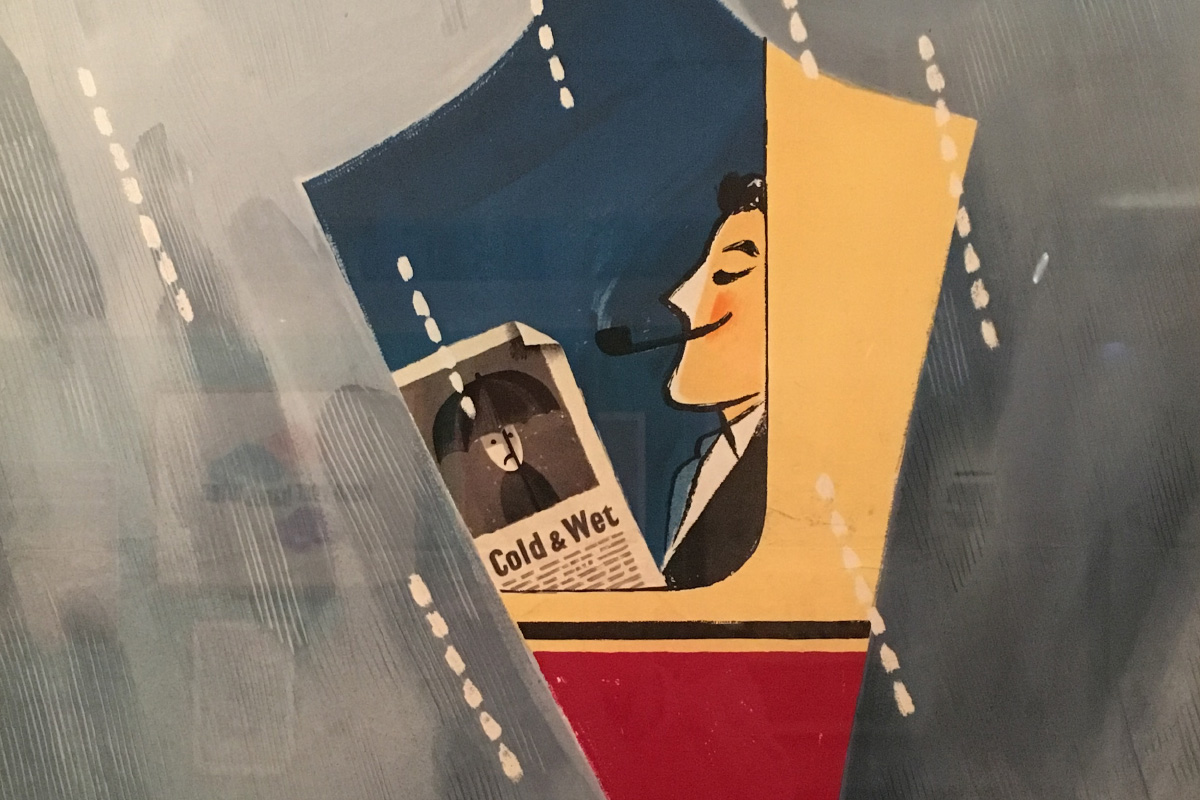
Put on to celebrate the 150th birthday of the London Underground, the densely packed show is a collection of 150 of the best posters produced for the tube. It features a stack of brilliant designs from the big names in poster design, including Abram Games, Edward McKnight Kauffer, Frederick Charles Herrick, Tom Eckersley, Edward Bawden, Fougasse (above); as well as a few fine artists, including Man Ray and Howard Hodgkin.

The show is split into six thematic areas, which neatly sidesteps the possible problem that might have occurred had the exhibition been chronological – namely that the more recent designs just aren’t as good. Partly this is due to the rose-tinted nature of nostalgia, but it’s not just that – the earlier designs have an energy, simplicity and wit that seems to have faded away from most of the contemporary designs we see now on the tube. Hopefully this show might serve as an inspiration though, both to the commissioners at the tube, and also to designers.

And you know, it’s interesting to stop there and linger on that word ‘designers’.

It feels like most of the contemporary commissions on the underground are given over to fine artists rather than designers. Witness the Olympic and Paralympic Posters for London 2012, Mark Wallinger’s Labyrinth, and The Roundel: 100 Artists Remake a London icon – all commissioned through the Art on the Underground programme. Where are the commissions for designers? Surely a show like this demonstrates just how brilliant a tradition of design London Transport has – it’d be great to see them embracing that by commissioning more contemporary designers, rather than just fine artists.

Anyway, here are some of our picks from the exhibition:

‘A train every 90 seconds’, the first poster Abram Games designed for London Underground, in 1937.

‘Behind the seen’, one half of a pair poster by James Fitton from 1948.

‘The lure of the Underground’, by Alfred Leete (the chap behind the Britons: Lord Kitchener Wants You poster) from 1927. This is a glorious poster – a fantastic economy of line, with wonderful characterisation, as you can see in the detail below:

Austin Cooper’s poster advertising the V&A’s first major poster show in 1931, and depicting Mercury, the winged messenger of the gods.

One of the highlights of the show is the fantastic array of different and frequently bonkers typographic styles. Here are some lovely ligatures from Frederick Charles Herrick’s ‘The lap of luxury’ poster from 1925:

And two Os getting up close and personal in Charles Paine’s ‘Boat Race’ poster from 1921:

And Alan Rogers’ lovely styling of the word Underground from his 1930 ‘Speed Underground’ poster:

Tasty stuff.

‘For the Zoo’, from 1933, by Maurice A. Miles, one of many posters for London Zoo featured in the show.

‘Away from it all’ by M.E.M. Law in 1932 – has a tube train ever looked so dynamic?

And finally, ‘Cup final’ by Eric George Fraser in 1928, which puts you right in the heart of the action.

The show runs until 27 October, and is really outstanding – do get along if you can.

Revamped

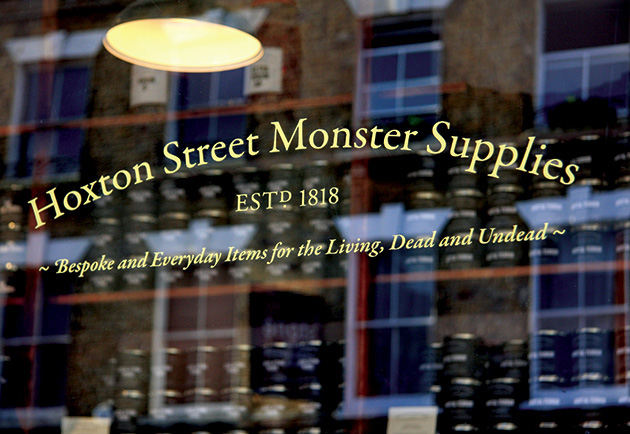
Sorry, we know we’ve been blithering on about Hoxton Street Monster Supplies a lot, but we’ve just been doing a heck of a lot of stuff with them lately.

Since there’s been such a lot of new stuff going on inside, we thought it would be a good time to refresh the outside too.

So we commissioned traditional signwriter Nick Garrett (and his partner Mat) to completely revamp the shopfront. We gave Nick a carefully set layout of all the text, and he tweaked and nudged it to make it appropriate for the front of a shop.

They then marked up the facia with a chalk trace down, and set to work.

Nick used a bespoke colour mix of signwriting enamel for the lettering.

Mat, getting busy with the Ministry of Stories logo.

That’s rather a lovely Q isn’t it?

The panels beneath the windows and on the doors detail all the products the shop sells.

Particular respect to Mat for the many many hours of care and attention he lavished on the Official Notice on the shop’s door.

Lovely stuff.

Monstrous cards

When an email doesn’t cut it, and howling at the moon is just a waste of breath, it’s time to send a card. So we’ve created a set of greetings cards for Hoxton Street Monster Supplies.

There are eight designs, which cover a whole variety of possible circumstances.

For Christmas, you can share your festive feelings in style (particularly if you send a jar of actual Bah! Humbugs too…)

If you’re feeling a little more positive, or as is more likely, you know someone who’s recently become a zombie, this card would be the one for you:

Or perhaps it’s just time to show someone how grateful you are:

Every monster loves Hallowe’en, so we thought a card for that might be good:

Sometimes you want to be a little more subtle though – after all, a whisper can be more powerful than a shout:

The shop gets visits from many a mummy (and little monsters should never hesitate in sending their mummies a card):

And of course, even fiends find time to celebrate Valentine’s Day:

The cards, printed with woodblock letters, have been lovingly set and printed by the fine folks at New North Press, on 270gsm Colorplan White Frost supplied by the good people at GF Smith. Huge thanks to them all.

They’ll be available from Hoxton Street Monster Supplies just as soon as their mindless lackeys have finished packaging them up.

Being for the Benefit of Mr Kite!

So this is rather fine. A facsimile version of the playbill poster that inspired John Lennon to write Being for the Benefit of Mr Kite! from Sgt Pepper’s Lonely Hearts Club Band, printed by the lovely folks at New North Press, with wood engravings by Andy English.

Here are the lyrics:

For the benefit of Mr. Kite
There will be a show tonight on trampoline
The Hendersons will all be there
Late of Pablo Fanques’ fair, what a scene.

Over men and horses hoops and garters
Lastly through a hogshead of real fire
In this way Mr. K will challenge the world.

The celebrated Mr. K
Performs his feats on Saturday at Bishopsgate.
The Hendersons will dance and sing
As Mr. Kite flies through the ring, don’t be late.

Messrs K. and H. assure the public
Their production will be second to none.
And of course Henry the Horse dances the waltz.

The band begins at ten to six
When Mr. K performs his tricks without a sound,
And Mr. H will demonstrate
Ten somersets he’ll undertake on solid ground.

Having been some days in preparation
A splendid time is guaranteed for all
And tonight Mr. Kite is topping the bill.

Lovely stuff.

The Ministry Needs You!

How would you like to create your own branch of the Ministry of Stories and your own version of its shop, Hoxton Street Monster Supplies?

We’ve rambled on about both of them on here at great length (check out our blog post about the Ministry, and this project page; and this project page for the shop).

It’s been nearly two years since we helped to set them up, and since then the Ministry has provided thousands of local kids with free one-to-one writing mentoring and group workshops, all thanks to the work of an incredible team of volunteers, and to the fantastic co-directors Lucy Macnab and Ben Payne.

Last year we were nominated for a D&AD Award (in the Writing for Design category) for our work on it (if you’re a D&AD member, you can read the case study of the project on their website); and Alistair has recently been nominated for the Volunteer of the Year Award at the 2012 Social Enterprise Awards which take place next month.

We’ve carried on creating new products for Hoxton Street Monster Supplies, so you can now get a whole new set of Tinned Fear, jars of Moonlight (for Werewolves) and Sunlight (for vampires with S.A.D.), bars of Impacted Earwax, as well as Banshee Balls and Bah! Humbugs. Not to mention the Fairy Dust (made from real fairies), and Near Rings, which warn you of nearby peril. You can buy all of it at the shop, a lot of it at the Monster Supplies website, and now also get some bits at Harvey Nichols stores around the country.

We collaborated with the folks at Studio Weave to create a fantastic range of Salts made from Tears, which you can read more about on this post.

(We’ve got some other brilliant collaborations in the works, which will be launching over the next few weeks, and we’ll tell you about them mighty soon.)

Design is a huge part of the way the Ministry and the shop work.

Aside from all the products, they also publish collections of the kids’ writing, such as the Awfully Bad Guide to Monster Housekeeping (designed by Ed Cornish)…

… as well as a regular newspaper, Hoxton A.M., also written by the kids (designed by Alex Parrott).

The Ministry also launched a Children’s Republic of Shoreditch over the summer, with its own Embassy (all designed by Burgess Studio).

So, it’s been a busy two years.

Over that time, the Ministry has had lots of requests from people around the UK eager to open up their own Ministries, with their own accompanying shops.

And the Ministry has now officially opened applications for people wanting to do just that.

So if you’re a designer, or work at a design group, somewhere in the UK (outside of London*), and would be interested in helping to set up a Ministry in your area, now’s your chance. It takes quite a bit of work, but it’s ridiculously rewarding, and we’d recommend doing it in a heartbeat. Quite what forms your versions of the Ministry and the shop take is entirely down to you. (You might want to take a look at the 826 project, and its associated stores, which was of course our inspiration to begin with.)

The application process is quite hefty, and there’s quite a long lead time before you become an actual Ministry, but that means that there’s plenty of time to come up with some truly brilliant ideas. You might already know educators / writers / volunteers in your local area, but if not, get in touch with the Ministry, and if there are other people thinking about setting something up near you, they can pass your details on.

Any questions, stick them in the comments section below, and we’ll do our best to answer them.

*If you are a designer in London, and would like to help out with the stuff we’re doing, just give us a shout. We can always do with more help!

Union Jack 2014

Yesterday saw the signing of the Edinburgh Agreement, which announces a referendum on Scottish Independence in 2014, and thus the possibility of Scotland leaving the UK and becoming independent – the ending of a 305 year old political union.

This got us thinking about the Union Flag (more commonly known as the Union Jack, though strictly speaking that name is reserved for flags flown at sea), and how it might change if Scotland did go its own way.

The current flag is made up of three separate flags: the St George’s Cross of England, the St Andrew’s Cross of Scotland, and the St Patrick’s Cross of Northern Ireland:

They all come together, with a bit of jiggling, and a few fimbriations (the white outlines around each of the crosses) to make the current Union Flag:

But if Scotland runs off to do its own thing, then it seems to make sense that the flag should change (even though under the current proposals Scotland would hang onto the monarch as the head of state). If you whip out the St Andrew’s Cross from the flag, and balance out the weight of the St Patrick’s Cross, you get this:

But hang on. The flag would be representing The United Kingdom of England, Wales and Northern Ireland, but currently Wales isn’t represented in the flag (it was already part of the Kingdom of England when the flag was put together). That seems more than a little wrong. So perhaps we might see Wales take up its place in the flag, either as we’ve shown up top, or perhaps as below:

Or maybe it’s time for something different entirely.

Just spare a thought for all the flag-makers, and not just the ones for the UK, but for all the other nations and colonies that feature the Union Flag in the canton (the upper left hand quadrant) of their flags.